

Ignite Confidence with Early Success
*
Ignite Confidence with Early Success *

Create the First Wins
New challenges or change can feel daunting, but a single quick win can help so much to spark the beginning. "Create the First Win" is about designing an early success for the person you are guiding. It is something small, achievable, and meaningful that proves they can do it. As part of the Seed stage and inspired by Dan Heath’s Switch, this tool builds momentum by showing progress right away.
Let’s design a victory that sparks belief and sets the stage for bigger growth.
A Quick Guide - Design, Deliver, Delight
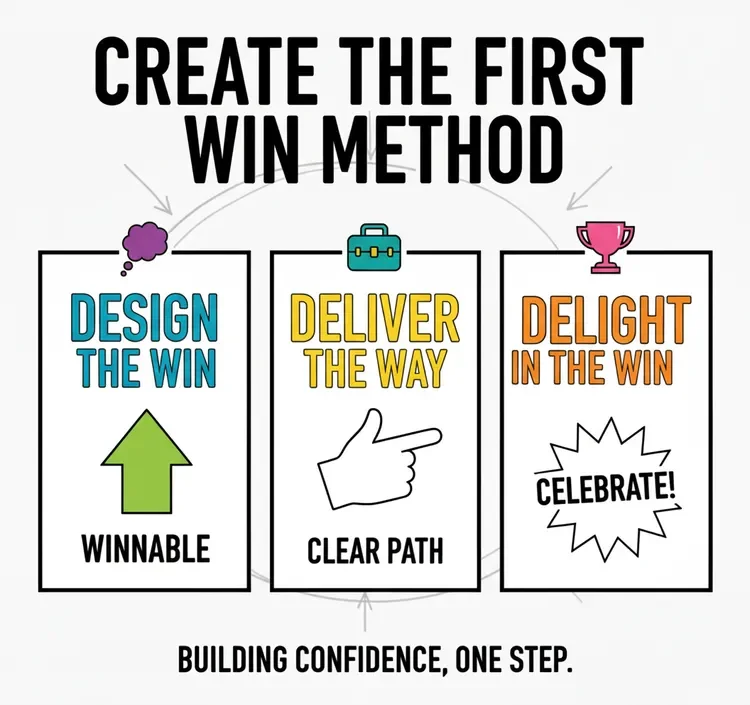
When you want to create a first win, think about a small, guaranteed success you can create to build their confidence. These steps will break it down for you:
Design the win: Choose a small, specific task tied to their larger goal. It needs to be one with a high chance of success and a clear endpoint. Make it winnable. Example: For a team member hesitant to speak up, ask them to share one idea in a low-stakes, one-on-one chat.
Deliver the way: Set them up to succeed by providing clear instructions, resources, or support. Remove any risk of failure. Example: Give them a prompt like, “Tell me one thought about this project,” and ensure a safe, encouraging space.
Delight in the win: Think about how you can celebrate the win immediately, no matter how small. Highlight their effort and connect it to future potential. Example: Say, “That was a great idea! Sharing like this is how we’ll build amazing projects together.”
Ready to design their first win? Use our step-by-step guide to craft a quick success.

Creating First Wins In Action
For Leaders
Common Problem: “My team feels defeated after setbacks and lacks confidence to try again.”
First Win Strategy: Pick a small, achievable task for the team or an individual, something they can complete in a day or less. For example, ask a quieter team member to lead a 5-minute update in a small group setting. Deliver support by prepping them with a simple outline and ensuring a supportive audience. Delight by praising their effort publicly: “Thanks for stepping up today, that’s leadership in action!”
Micro-Challenge: Identify one team member who needs a boost and design a small, winnable task for them today (e.g., “Lead a quick brainstorm for 5 minutes”). Celebrate their completion with specific praise.
For Parents
Common Problem: “My child doubts their abilities and gives up easily on tasks like studying or tidying.”
First Win Strategy: Select a tiny, specific action tied to a bigger goal, ensuring they can’t fail. For example, if they struggle with tidying, ask them to organize just their desk drawer with your help. Deliver by guiding them through it step-by-step and keeping it fun. Delight by celebrating with enthusiasm: “Look at that drawer! You’ve got this organizing thing down, let’s do another spot soon!”
Micro-Challenge: Choose one small task for your child today (e.g., “Sort one pile of toys”) and make it a guaranteed win with your support. Celebrate with a high-five or small reward.
Why It Works – The Science Behind First Wins
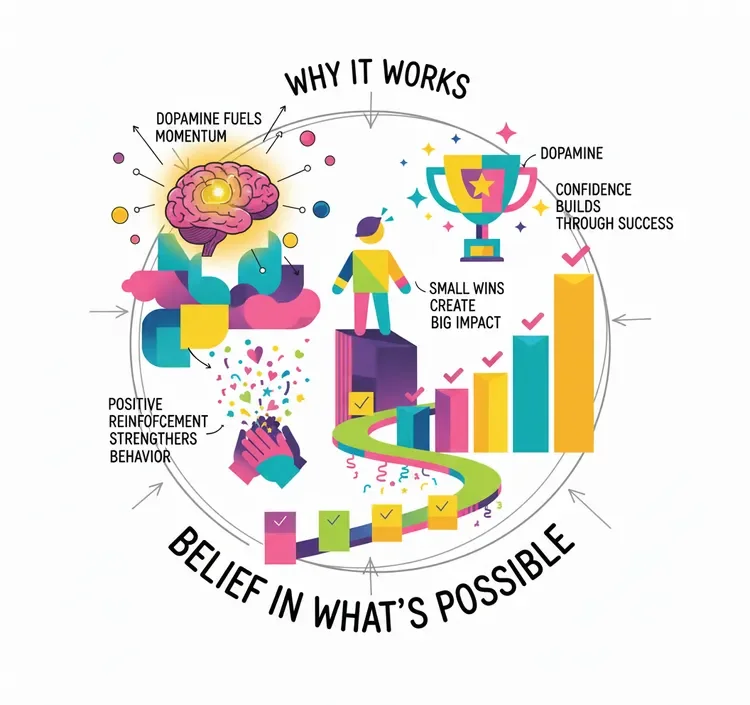
Dopamine Fuels Momentum: Completing even a small task releases dopamine, the brain’s reward chemical, creating a positive feedback loop that motivates further action (Dr. Andrew Huberman, 2021). A first win triggers this cycle early.
Confidence Builds Through Success: Early successes, no matter how small, shift self-perception from “I can’t” to “I did it,” increasing self-efficacy (Bandura’s Self-Efficacy Theory, 1977). This belief drives persistence.
Small Wins Create Big Impact: Research shows that small, visible progress is disproportionately motivating compared to distant goals (Teresa Amabile, The Progress Principle, 2011). A first win makes growth feel real.
Positive Reinforcement Strengthens Behavior: Celebrating early wins reinforces the behavior through emotional reward, making repetition more likely (Laurie Santos on motivation science). It’s not just a win, it’s a mindset shift.
By creating a first win, you’re building their belief in what’s possible.
NEXT: Grow Motivation
You can’t motivate others! Or Can you? And is it manipulation to do so?


BACK: Shrink the Change
What About Pebbles instead of Milestones? Too Small? To Spark Change They Are Key!