Rise After Falls
Root Change by Preparing for Setbacks
Change isn’t a straight line. Setbacks are inevitable and they don’t have to be endpoints. "Rise After Fall" is about equipping the person you’re guiding to handle challenges, transforming stumbles into stepping stones by preparing them for recovery and tying persistence to their identity. Let’s build their capacity to bounce back stronger.
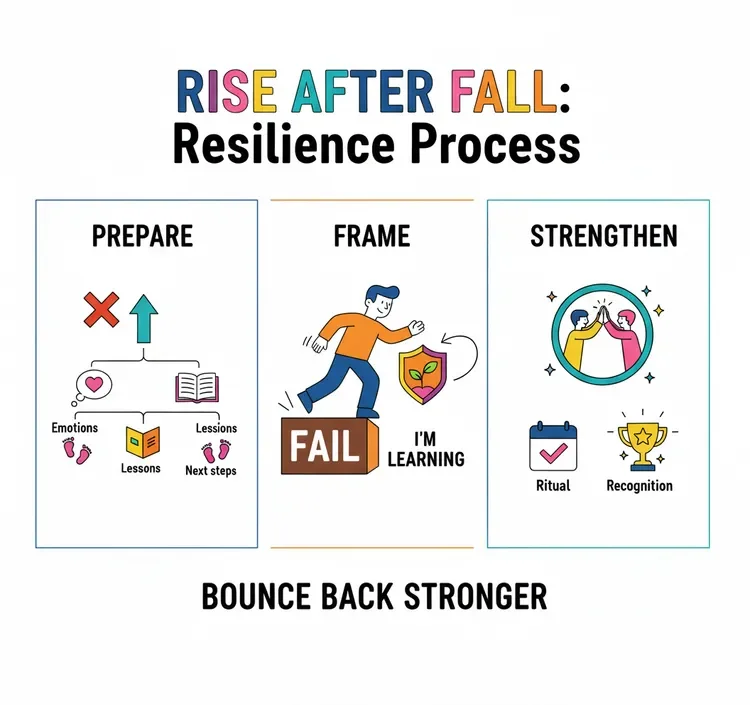
Quick Start Guide – Prepare, Frame, Strengthen
Rising after a fall means guiding someone to navigate setbacks with a clear, science-backed process that anchors resilience in their mindset and support system. Here is how:
Prepare: Co-create a simple recovery protocol before setbacks occur, focusing on processing emotions, extracting lessons, and planning small next steps to avoid reactive spirals.
Frame: Shift their perspective on falls from “I failed” to “I’m learning,” linking setbacks to an identity of persistence to maintain a positive self-view during challenges.
Strengthen: Reinforce resilience with supportive rituals and celebrations of small comebacks, embedding persistence as a core part of who they are through consistent encouragement.

Rise After Fall In Action
Here are practical ways to apply this tool across relationships and goals.
Try a micro-challenge today to make resilience a rooted strength with innovative recovery strategies.
For Leaders
Common Problem: “My team member loses confidence and momentum after a project failure or criticism.”
Prepare: Develop a recovery protocol with them: “After a setback, let’s take 10 minutes to name how you feel, identify one lesson, and plan one small step forward.”
Frame: After a failure, reframe it by saying, “You’re a persister, this is just a detour. What did you learn, and what’s your next move?”
Strengthen: Reinforce resilience with a ritual like a brief “comeback chat” after setbacks to discuss emotions and ideas, and celebrate their first action forward with praise: “That’s persistence in action!” This evokes resilience by making recovery a natural response.
Micro-Challenge: Create a simple 3-step recovery protocol (feel, learn, act) with a team member today. After their next setback, test it, frame the fall as a learning moment tied to a “persister” identity, and strengthen with a small ritual or recognition.
For Parents
Common Problem: “My child gives up after failing a task like homework or a game, feeling defeated.”
Prepare: Establish a recovery protocol: “After a tough moment, let’s talk for 5 minutes about how you feel, find one thing you learned, and try one small thing next.”
Frame: After a struggle, reframe: “You’re a persister, this is just a step to getting better. What did you figure out, and what can we try now?”
Strengthen: Reinforce resilience with a ritual like a quick “comeback hug” to share feelings, and celebrate their next try with a high-five or “I’m proud of my persister!” This evokes resilience by making recovery a supported, positive experience.
Micro-Challenge: Set a simple recovery protocol with your child today. After their next setback, use it, frame the fall with a “persister” identity, and strengthen with a small ritual or recognition, noting their response..
WHY IT MATTERS
*
WHY IT MATTERS *
THE SCIENCE BEHIND
RISE AFTER FALL
Emotions Fuel Recovery: Stanford research shows that processing emotions after setbacks speeds recovery by 2.5 times compared to “powering through” (Dr. Kelly McGonigal, 2015). Feelings aren’t obstacles—they’re fuel for growth.
Identity Protects Resilience: Separating behavior (“I made a mistake”) from identity (“I am a failure”) activates problem-solving brain regions over threat responses, boosting recovery by 70% (MRI studies, 2021). A persistent identity safeguards self-worth.
Social Connection Accelerates Comebacks: Strategic social engagement post-failure increases recovery speed by 70% via oxytocin release, even for introverts (Social Cognitive and Affective Neuroscience, Eisenberger, 2022). Support amplifies resilience.
Structured Recovery Enhances Outcomes: Studies indicate that having a predefined protocol for setbacks reduces emotional overwhelm and increases proactive behavior by 40% (Amy Edmondson, The Fearless Organization, 2018). Preparation prevents paralysis.
Positive Framing Rewires Mindset: Reframing failures as learning opportunities engages the prefrontal cortex, calming fear responses and enabling focus (Andrew Huberman on goal-directed behavior, 2022). It shifts “I can’t” to “I’ll grow.”
Reinforcement Builds Persistence: Dan Heath’s Switch (2010) shows that evoking small wins and support motivates more than criticism. Modern strategies like rituals and celebrations help the brain predict recovery over defeat (Lisa Feldman Barrett on emotion construction, 2017).

Back: Turn Action
Into Identity
Shift their self-view from “I do this” to “I am this kind of person to root change.
Grow Others Toolbox
All In One Place
Want to revisit a tool or see what you might have missed?