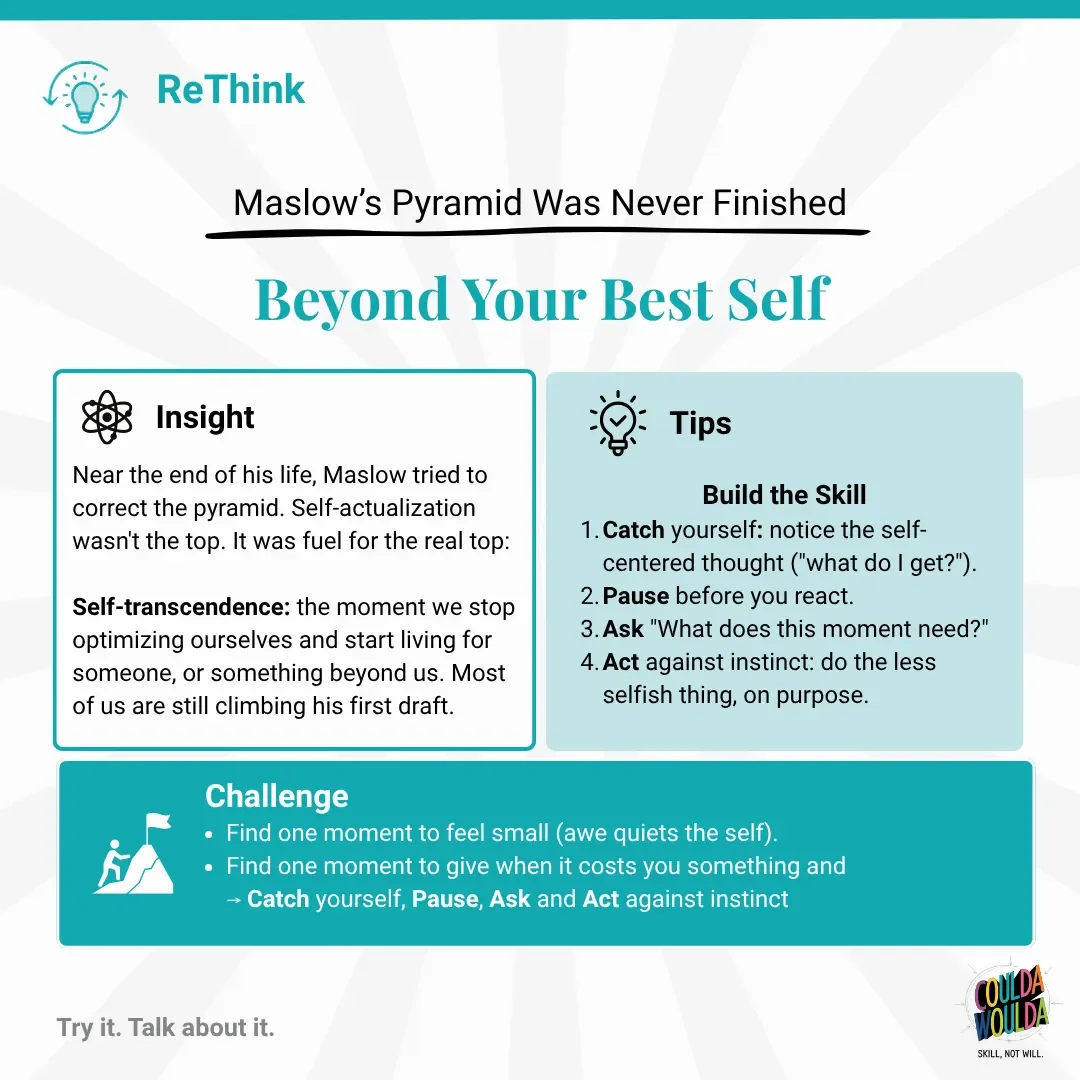
Maslow’s Final ReThink: Beyond Your Best Self
The Pyramid Was Never Finished
When you search "Maslow's Hierarchy of Needs," you'll get the same tidy pyramid taped to classroom walls since the 1960s: physiological needs at the bottom, self-actualization crowning the top like a finish line. Here's what the search results won't tell you: Maslow never drew that pyramid. Someone else simplified his work decades later into a shape clean enough for a textbook.
By the end of his life, he tried to correct the record. But the pyramid had already gone “viral”. The world ran with the wrong ending, and still is. We built an entire industry on that unfinished peak: optimizing our mornings, hacking our sleep, chasing our best selves like self-actualization was the finish line instead of a gateway. More productive. More impressive. More optimized. But that was never the peak. Maslow knew it. He just ran out of time to say it loud enough.
The Villain We All Know
Hustle culture doesn't look like a villain. It looks like ambition: 5 a.m. alarms, optimized morning routines, productivity apps, cold plunges, personal branding, relentless self-improvement. All in service of a single, unspoken promise: if we just optimize enough, we'll finally arrive. But arrive where?
The self-optimization industry has convinced millions of people that the summit of life is a better version of themselves. Stronger. Smarter. More disciplined. More efficient. And when we hit the goal, land the title, build the body, achieve the metric… we feel disappointed, or empty. Because self-actualization was never supposed to be the end. It was supposed to be the gateway.
The Missing Piece: Self-Transcendence Is a Skill
Maslow calls what's on the other side of that gateway self-transcendence. It's the point where the question stops being "how do I become my best self?" and starts being "how do we matter to something beyond ourselves?" Not self-sacrifice. Not burnout disguised as generosity. A way out of the self-focus that self-actualization can quietly trap us in.
Here's the distinction worth sitting with: self-actualization is about becoming fully ourself. Self-transcendence is about setting that self down. And crucially we need the first to do the second well. We can't give from a self that's empty, confused, or still performing someone else's life.
But too many of us stop at self-actualization and call it the summit. We treat becoming our best selves as the destination, when Maslow's own late, unfinished writing argued the opposite: self-actualization isn't the finish line. It's the fuel. It's what gives you enough of a self to finally have something worth offering, and then to offer it without needing it back.
Self-transcendence isn't a personality trait some people have and others don't. It's a skill, and like any skill, it can grow. Just like strength training or meditation, it follows a predictable progression. We don't start by lifting the heaviest weight. We start by learning to notice the weight is there.
Stage 1: Noticing
Before we can transcend the self, we have to catch it in action. Most people never notice how often their internal monologue runs on self-reference: What does this say about me? Will I get credit for this? How do I look right now? Notice every time a thought centers on you - without judgment. Just noticing, to begin with.
Stage 2: Interrupting
Once we can see the self-referential loop, we can learn to interrupt it. When we catch a self-centered thought mid-stream, we can pause and ask one question: What does this moment need? Not: what do I need from this moment? You're not required to act differently yet. You're building the muscle memory of the pause.
Stage 3: Acting Against Self-Interest
This is where it gets uncomfortable, on purpose. Just like progressive overload in the gym, this stage deliberately increases the cost. We're not just redirecting neutral moments anymore, we're giving something up: The credit? Point it at someone else. Being right? Let someone else be right. The spotlight? Step back and shine it on someone standing next to you.
We're fully aware of what it costs us. The discomfort is the point. Resistance builds capacity.
Stage 4: Integration
Eventually, self-transcendence stops being a practice we do and becomes a lens we see through automatically. This is Maslow at the end of his life. This is the version of ourselves we glimpse in our best moments, where serving something bigger isn't effortful anymore. It's just who we've become.
You Don't Have to Save the World to Reach the Peak
Self-transcendence sounds like it should be big: a mission, a cause, a humanitarian who gives up everything for something greater than themselves. But that's not where it starts, or what it needs to be.
It can just be letting someone else take the credit. Actually listening instead of waiting for your turn to talk. Helping a stranger who'll never know it was you.
"Look how much I'm helping people" is still self-referential. It's self-actualization with a halo.
The small moments aren't practice for later. They are the thing. We don't have to save the world to get there. We just have to stop making everything about us — one small moment at a time.
What the Science Actually Says
This isn't just philosophy. It's biology.
Allan Luks spent years studying volunteers and found a consistent physiological response he called the Helper's High, which is a rush of endorphins triggered not by receiving help, but by giving it. Months later, he found these people had lower stress, less pain, and a calm that outlasted the act itself. Helping wasn't just a nice feeling in the moment. It left a residue.
And then there's awe. Brené Brown describes it as the feeling that arrives with both wonder and humility at once: the night sky, someone's quiet courage, a piece of music that stops you cold. Dacher Keltner's research found something remarkable happening in the brain during those moments: the regions responsible for self-referential thinking - the ones narrating me, my problems, my next move - go quiet. Awe doesn't just feel good. It shrinks the self, measurably, on a scan.
Different trigger all landing in the same place: a self that, for a moment, stops being the center of the story. This is biology confirming what Maslow saw coming.
Maybe a Situation You Can Recognize
"MUM." Then again, louder. "MUM!" Then the one where you can already feel the anger, the frustration, the urgency: "MUUUUM!"
And it's the middle of a work call, or the one hour today that was supposed to be for you: the workout, the pause after a long day, the moment you thought you were finally about to finish an important task.
And before you've even registered what they want, you feel annoyed. A sharp "WHAT?" comes out like a reflex. Stuck in your own thinking and needs, not thinking about what would actually be most effective and helpful in that moment.
Here's the important thing: there is a gap between the Mum-shout and the "WHAT." It might be half a second, but this is where Maslow's unfinished part comes in — we have a choice between running on autopilot, narrating my time, my interruption, my needs, or asking what does the situation need? It's not about being selfless. It's about being more effective, and more self-content, afterward.
In the kitchen, that gap looked like presence versus self-protection. But the gap doesn't stay in the kitchen. It shows up anywhere self-focus tries to make its case first:
Parenting: Protecting energy, patience vs. Staying present despite depletion
Career: Protecting credit, image vs. Sharing credit, elevating others
Disagreement: Protecting being right vs. Staying curious, not defensive
Social media: Protecting the curated self vs. Sharing something real, unpolished
Grief or struggle: Protecting yourself from vulnerability vs. Letting someone in
THE 7-DAY CHALLENGE
DAY 1: NOTICE
Every time a thought concerns yourself How do I look? What do I get? - notice it, without judgment.
DAY 2: INTERRUPT
When a moment of friction arises, before you react, ask: "What does this moment need?"
DAY 3: REDIRECT CREDIT
Something goes well today. Point the credit at someone else, genuinely, and out loud.
DAY 4: LISTEN TO CONNECT
Have a conversation where you're not composing your response while they talk. Ask follow-up questions instead.
DAY 5: GIVE ANONYMOUSLY
Help someone who will never know it was you. No post. No mention. Just act.
DAY 6: LET SOMEONE ELSE BE RIGHT
Find one moment where you want to be right, and let it go. Accept their view as valid without disagreeing.
DAY 7: INTEGRATE
Part One (private): Write one sentence about a moment this week you served without needing credit. What did it cost you - what did it give you instead?
Part Two (public): Write one line for someone else, a friend, family, or on social media: what would you want someone to read right before their own half-second moment. Share that one.
The Only Question Left
So the call comes in again tomorrow. "MUM!"
This time, in the half-second before you answer, we notice the gap. we notice the pull toward my time, my task, my exhaustion. And we choose to walk toward the noise, get down and ask what they need. It costs us something: the momentum of our task, or the last five quiet minutes we were counting on. The reward wasn't instant and quiet It was quiet: lower stress, less physical pain, a calm that lingered for hours after the moment had passed.
Same gap, a half-second to respond: The phone buzzes on our next call. Someone takes credit for our idea. A stranger needs ten seconds we don't think we have to spare. Someone disagrees with us in a room full of people. Our choice: My universe, or something bigger?
What would it look like if we stopped measuring success by how high we climbed and started measuring it by how many of those half-seconds we chose well?