

If You Start with “Don’t,” It’s Not a Boundary
The Power Shift: Why Real Boundaries Are About What You Do (Not What You Ask Others To)
We’ve all been there. We want something to stop happening, so we say:
“Don’t interrupt me.” - in meetings when someone cuts us off repeatedly
“Don’t jump on that.” - with our kids when we see danger ahead
“Don’t show up unannounced.” - to our parents-in-law who add extra stress
It feels like we are setting a boundary. It might even take courage and sound firm. But these statements aren’t boundaries, they are requests, wishes, or complaints.
A “Don’t” still requires the other person to change for us to feel okay, which gives away our power.
The Core Insight
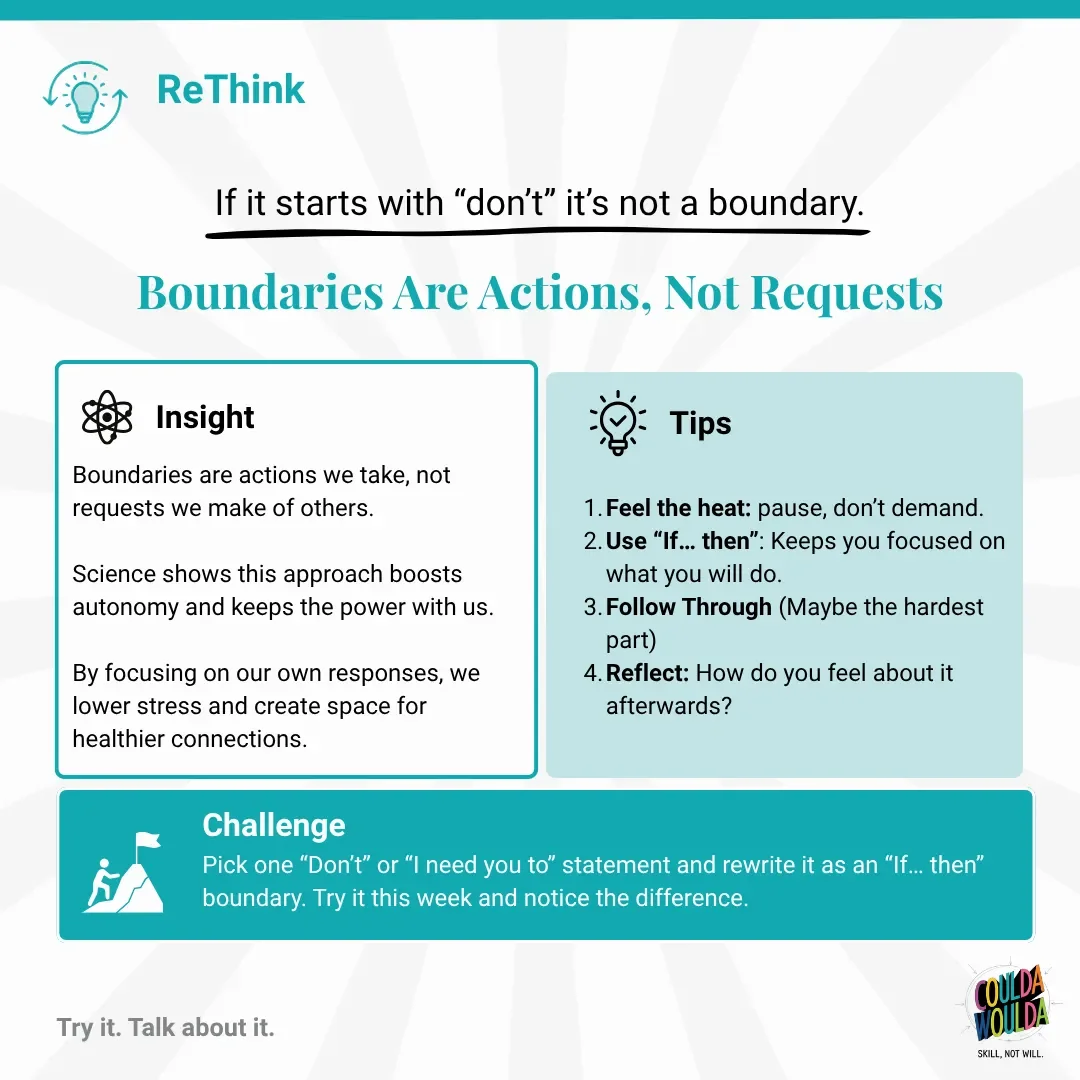
A boundary is not something we ask someone else to do.
A boundary is something we do when we decide what we will and won’t participate in.
When we set a real boundary, the power stays with us. We are not waiting for cooperation, but stating what we will do next.
This shift moves us from:
“You need to stop doing X” → “If you keep doing X, here’s what I will do.”
A boundary is no longer about controlling other people’s behavior. It’s about protecting our time, energy, or peace, and it only requires us to act.
Some Examples
“Don’t interrupt me.” → “If you keep on interrupting me, I will pause the conversation until we can continue respectfully.”
“Don’t raise your voice at me.” → “If you keep yelling, I’m going to leave the room until things calm down.”
“Don’t jump on that.” → “If you can’t stay still, I am going to help you come down.”
How to Actually Set Boundaries (The Internal Shift)
Here’s the practical framework:
Get clear on what you control
Ask: “What am I willing to do or stop doing?” This is the only part that matters.State the boundary as an “If… then”
If … happens → I will do ….
It removes the need for the other person to agree.Follow through (the hard part)
A boundary without action is just a wish. The power lives in your consistent behavior.Release the outcome
Some relationships may shrink. That’s okay. You’ll stop resenting the ones that remain.
Why This Feels So Liberating
When we understand that boundaries are our actions, several things happen:
We stop waiting for other people to change before we can feel okay
We take responsibility for our own peace instead of outsourcing it
We become less reactive and more intentional
Our relationships become more honest (with less resentment)
Why This Works: The Science Behind It
This approach isn’t just empowering, but also backed by psychology and neuroscience:
Self-Determination Theory (Deci & Ryan): Setting boundaries that focus on your own actions boosts autonomy, one of the core psychological needs. When we feel in control of our responses, motivation and well-being increase.
Stress Response Research: “Don’t” statements often trigger defensiveness (activating threat-detection systems). In contrast, “If… then” boundaries reduce conflict and lower cortisol levels for both parties.
Emotional Regulation & Mirror Neurons: Dr. Becky Kennedy and relational neuroscience show that modeling calm, self-directed limits helps regulate the emotional climate, making connection more possible over time.
In short: boundaries that start with us activate agency and calm instead of threat and resentment.
My Personal Take-Away After Practicing Holding Boundaries
After working with this approach, I’ve learned a few key things:
I need to become aware of the exact moment when the heat rises so I can set boundaries in the moment. That means mentally preparing for situations like these:
My kid coming home from school and releasing all their tension
My colleague getting frustrated with my request
My parents-in-law showing up whenever they feel like it
My boss sending a meeting request on my day off
Having a ready “If… then” phrase for those moments makes all the difference.
My tendency to people-please gets easier to manage over time when I actually follow through.
The surprising outcome? This approach has often strengthened my relationships:
People respect me more because they see I can stand up for myself and address the hard stuff.
With my kids, it gives them the security of a steady parent who has their best interest at heart, even when they’re overwhelmed (though they won’t thank me for it right away 😉).
And with my parents-in-law, clearly stating my needs actually made it easier for them to share theirs too.
Boundary-Challenge This Week
Pick one area where you’ve been leading with “Don’t” or “I need you to…”.
Rewrite it using the “If… then” structure.
Notice what happens in the other person and inside you (in the moment and after a couple of repetitions)
So what are the boundaries you commited to or already tried out? Comment below or on Social Media.